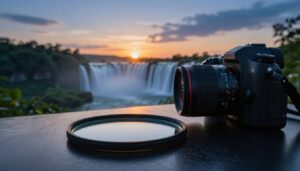
I often find that choosing the right filter is essential for landscape photography. When I work outdoors, I use a protective piece of glass on my lens to manage tricky light and reflections glare.
That small change can transform an ordinary scene into a striking image. I rely on a polarizer to cut reflections and on neutral density tools to slow shutter and capture motion in clouds, water, and foliage.
I keep my camera settings simple and focus on how these accessories control exposure and shutter speed. Using slow shutter speed brings motion and softens water for creative effects.
Key Takeaways
- Understand that a filter is protective glass that changes how light reaches your lens.
- A polarizer helps reduce reflections and deepen skies.
- Neutral density tools let you use slow shutter speed for motion in water and clouds.
- Mastering shutter speed is key to consistent landscape exposures.
- Controlling light with the right accessory improves every image you take.
Understanding the Basics of Polarizing vs ND Filter
I find many photographers mix up two common lens accessories because both change how light reaches the camera. But they serve different purposes and produce very different effects in a scene.
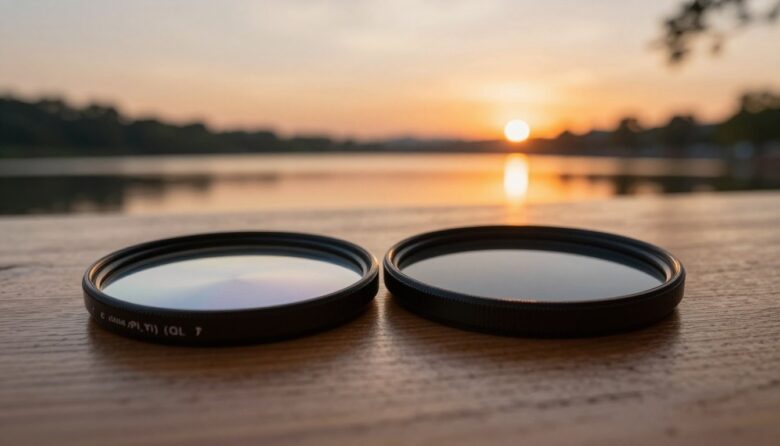
A polarizing filter is a single glass element you screw onto a camera lens to reduce reflections and glare. It helps deepen skies and cut unwanted shine on leaves, water, or glass without changing exposure.
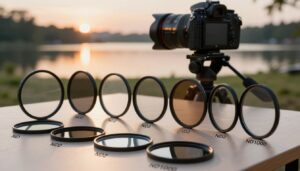
Neutral density tools, by contrast, manage the amount light entering the lens. I use neutral density filters to lower brightness so I can slow shutter speed and capture motion in water or clouds. They do this without altering color balance.
- Many photographers think filters often do the same thing; they do not.
- When I compare polarizing vs ND filter, I check whether I need to reduce reflections or reduce amount light.
- Using the right density filter helps me keep the image from overexposing in bright sun.
Choosing between these lens filters depends on whether you want to control glare or control exposure. Both are essential to modern landscape photography.
Mastering Circular Polarizers for Vibrant Landscapes
When sunlight hits reflective surfaces, a circular polarizer becomes my go-to tool for clarity.
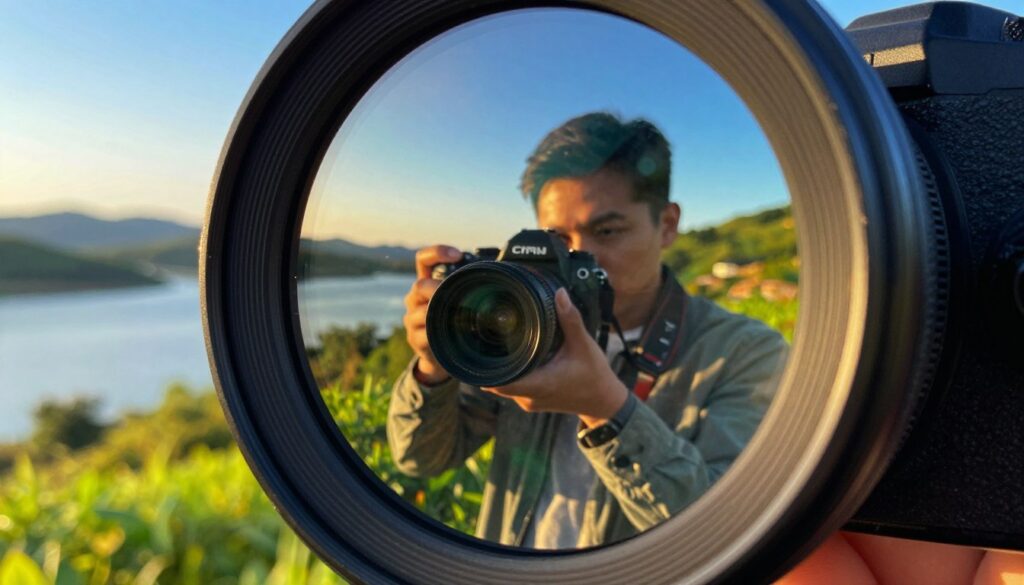
The QuartzLine Circular Polarizer is built for landscape work. It uses two optical elements in one unit and lets the front element rotate to control the light that reaches my camera.
I rely on my circular polarizer to manage reflections glare on water and glass. That control lets me reveal details beneath the surface and keep highlights from blowing out.
Managing Reflections and Glare
By rotating the front element I can dial how much polarized light is blocked. This is essential when I want clouds to pop against deep blue skies or when I want foliage to look fuller.
Boosting Color Saturation
Using a polarizer filter boosts color without heavy editing. I see richer greens and clearer water in my final image, and the scene feels truer to what I saw that morning.
“A good polarizer turns a flat photo into a more vibrant, three-dimensional scene.”
- I use lens filters that reduce shine and improve contrast.
- The QuartzLine option is one of the best filters offer for outdoor photographers.
- These types give me precise control and work well with varying shutter speed choices.
Controlling Light and Motion with Neutral Density Filters
Slowing the world down starts with reducing how much light hits my sensor so I can keep the shutter open longer.
Neutral density filters let me choose wider apertures and long exposures without blowing highlights. I use a density filter to cut the amount light entering my camera and shape how motion appears in the frame.
Achieving Silky Water and Motion Blur
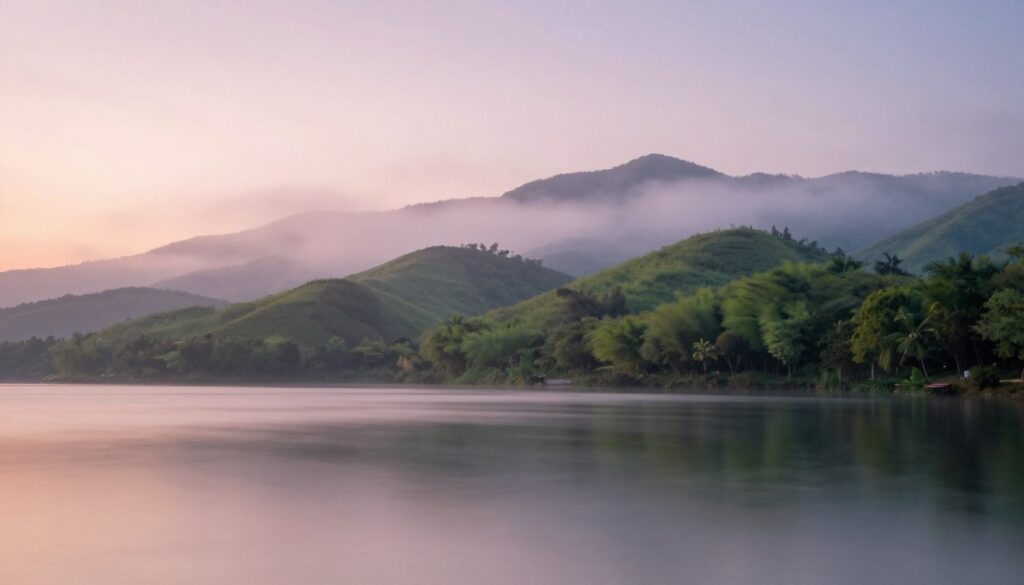
When I want a waterfall to look like silk, I pick a high-density option. PolarPro ranges from an ND4 (2-stops) to an ND100k (16.6-stops), so I can force my shutter to stay open for several seconds or minutes.
The Cinema Series Glass in these neutral density filters keeps my image sharp and color-accurate. That glass has low refractive index and precise transmission, so the long exposure retains detail without strange color shifts.
- I use a neutral density filter to reduce amount light and enable slow shutter speed for motion effects.
- High-density filters produce smooth water and streaking clouds with minimal blur artifacts.
- An ND4 or an ND100k gives consistent control over exposure in bright scenes.
Combining Filters for Advanced Creative Results
Stacking the right glass can turn a simple vista into a cinematic landscape. I use combined lens elements to manage reflections, color, and exposure in one pass.
The Benefits of Stacking
Stacking a circular polarizer and an ND filter lets me cut glare while dialing in longer exposures for silky water and soft clouds. I often start with a polarizer filter to deepen skies and reduce reflections glare, then add density glass to slow shutter speed.
Managing Complex Lighting
When a bright sky meets shaded foliage, layered filters help me balance the scene. Kase and other makers design lens filters that stack cleanly so I can control amount light without odd color shifts.
Tips for Sharpness
Keep both elements spotless and tighten mounts to avoid light leaks. I check focus after stacking and use a small aperture if I need depth. This keeps the image sharp and preserves fine detail when I chase motion blur with longer exposures.
“Experimenting with stacked filters expanded my creative range and helped me capture scenes I only imagined.”
- I recommend polarizer first, then density glass to slow shutter speed.
- Clean glass and secure mounts reduce artifacts and maintain sharpness.
- Try different combinations to see how polarizers and density elements change the final image.
Conclusion
Your choice of lens glass shapes the mood of a landscape more than camera settings alone. I find a polarizer best for cutting reflections and boosting color, and a polarizing filter can make skies and foliage pop with little post work.
When I need to slow time, a neutral density option controls how much light reaches the sensor so I can push shutter speed for smooth water and streaking clouds. This helps me craft cleaner exposures and predictable motion in a final image.
Mastering both tools and combining filters when needed raises the quality of an image and advances your landscape photography. Practice with good glass and keep experimenting — the results will reward your patience.
FAQ
What is the main difference between a circular polarizer and a neutral density lens accessory?
A circular polarizer reduces reflections and boosts color saturation in skies and foliage by controlling polarized light, while a neutral density option cuts the amount of light entering the camera so I can use slower shutter speeds for motion blur and longer exposures.
When should I use a polarizer vs a density accessory for landscape shots?
I reach for a polarizer when I want to reduce glare on water or glass and deepen the blue in the sky. I choose an ND product when I want silky water, streaking clouds, or to use wide apertures in bright sun without overexposing the image.
How do I manage reflections and glare on wet rocks or foliage?
I rotate the circular polarizing element while looking through the viewfinder until reflections drop. That control helps me capture texture and color in wet surfaces and leaves without heavy post-processing.
Can I stack a polarizer with a neutral density piece, and what are the benefits?
Yes. Stacking lets me reduce reflections and lower exposure simultaneously, so I can get saturated colors and multi-second shutter speeds for motion. I watch for vignetting and loss of sharpness at wide angles when I combine elements.
Will combining these accessories affect image sharpness or cause vignetting?
Combining multiple elements can introduce softness, reduced contrast, or corner darkening, especially on wide-angle glass. I use high-quality circular polarizers and slim ND options, and stop down slightly if I need maximum edge-to-edge sharpness.
How much light do neutral density pieces usually reduce, and how does that impact shutter speed?
ND products are rated in stops; each stop halves the light. For example, a 6-stop density lets me go from 1/250s to about 1s, enabling pronounced motion blur. I plan exposures using the stops to reach the desired slow shutter speed.
Are there specific situations where a polarizer won’t help?
Yes. A polarizing element has little effect on direct sunlight areas or scenes without polarized reflections. It can also darken skies unevenly when used with wide-angle lenses, so I avoid it for some panoramas.
How do I control complex lighting when combining a polarizer and ND element at sunrise or sunset?
I meter the scene, set the ND for the base exposure I need for motion, then rotate the polarizer for reflection control. I bracket exposures or use graduated solutions for high dynamic range scenes to keep highlights and shadows balanced.
Does using a polarizer change exposure, and should I compensate with shutter or aperture?
A polarizing element typically reduces light by about 1–2 stops depending on angle. I compensate by slowing the shutter or opening the aperture, or by adjusting ISO if needed, to maintain correct exposure.
What tips help me get silky water and long cloud streaks with minimal noise?
Use a sturdy tripod, set a low ISO, choose the right density to achieve multi-second exposures, and combine with a polarizer if reflections are distracting. I also use a remote release or timer to avoid camera shake during long exposures.