
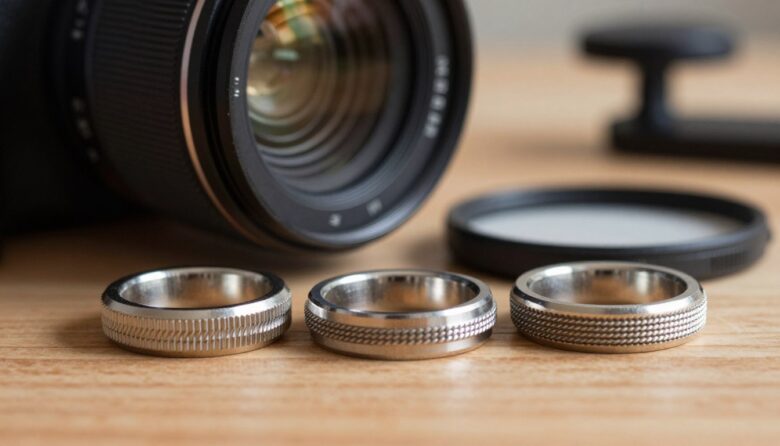
Step-up rings let photographers and filmmakers use one larger ND filter on several lenses with smaller filter threads. Instead of buying the same 3-stop, 6-stop, or variable ND filter in every lens size, you can build one shared filter system and add a small adapter for each lens.
This approach can reduce cost, save space, and keep the color behavior of your filter kit more consistent. It also requires a little planning because lens hoods, caps, wide-angle compatibility, and filter handling may change after an adapter is installed.
The basic strategy: buy your ND filters in the largest practical thread size used by your lenses, then purchase a direct step-up ring for each smaller lens.
For example, a 67–82 mm ring attaches an 82 mm filter to a lens with a 67 mm front thread.
What Is a Step-Up Ring?
A step-up ring is a thin threaded adapter. Its smaller side screws into the front of a lens, while its larger side accepts a filter with a wider diameter.
The ring does not contain glass and does not change filter strength, focal length, aperture, or shutter speed. It simply changes the physical thread size available at the front of the lens.
Do not confuse thread diameter with focal length. A lens labeled “24–70 mm” describes its focal-length range. Its filter size may be Ø77 mm, Ø82 mm, or another value. Look for the diameter symbol Ø near the front of the lens.
How Step-Up Rings Save Money
Suppose your camera bag contains lenses with 52 mm, 67 mm, and 77 mm filter threads. You also want a 3-stop ND, a 6-stop ND, and a 10-stop ND.
| Kit strategy | ND filters required | Adapter rings required | Total main pieces |
|---|---|---|---|
| Separate filters for every lens | 9 filters: three strengths in three diameters | None | 9 |
| Shared 77 mm filter system | 3 filters: one of each strength | 52–77 mm and 67–77 mm | 5 |
The shared system avoids buying six duplicate filters. The savings become even more significant when the kit includes premium variable ND filters, circular polarizers, diffusion filters, or several fixed densities.
Simple planning formula: a separate kit requires the number of lens sizes multiplied by the number of filter types. A shared kit generally requires one of each filter type plus one ring for each smaller lens.
How to Choose the Main Filter Size
- List every lens you plan to use. Write down the front filter diameter of each lens, not its focal length.
- Find the largest thread size. If your lenses use 49 mm, 58 mm, 67 mm, and 77 mm threads, a 77 mm filter is the logical shared size.
- Consider near-future lenses. If you expect to purchase an 82 mm professional zoom soon, building the system around 82 mm may prevent another replacement later.
- Avoid excessive oversizing. A very large filter can look unbalanced on a small lens, interfere with gimbals, and require larger caps and storage cases.
- Confirm accessory compatibility. Check whether the chosen size is available for your variable ND, magnetic system, filter holder, lens cap, and other accessories.
How to Read Step-Up Ring Sizes
| Ring marking | Lens thread | Filter size | Correct use |
|---|---|---|---|
| 49–67 mm | 49 mm | 67 mm | Mount a 67 mm filter on a 49 mm lens |
| 58–77 mm | 58 mm | 77 mm | Mount a 77 mm filter on a 58 mm lens |
| 67–82 mm | 67 mm | 82 mm | Mount an 82 mm filter on a 67 mm lens |
| 77–82 mm | 77 mm | 82 mm | Mount an 82 mm filter on a 77 mm lens |
Product listings are not always written consistently, so confirm which side is described as the lens thread and which side accepts the filter. The smaller measurement should match the lens, and the larger measurement should match the filter.
Step-Up Rings Versus Step-Down Rings
Step-Up Ring
Attaches a larger filter to a smaller-thread lens. This is the normal method for building a shared filter kit and usually presents a lower risk of blocking the lens’s field of view.
Step-Down Ring
Attaches a smaller filter to a larger-thread lens. The reduced opening can enter the frame and create hard dark corners, especially on wide-angle lenses.
A step-down ring may be usable on a long telephoto lens or in a cropped recording mode, but it should be tested carefully. It is not the preferred way to build a universal ND kit.
How to Install a Step-Up Ring Correctly
- Turn the camera off and place it on a stable surface. Working over a table or padded mat reduces the risk of dropping the filter.
- Inspect the threads. Remove sand, dust, and visible debris from the lens, ring, and filter before joining them.
- Align the ring carefully. Place it flat against the lens thread. If it tilts or resists immediately, stop and begin again to avoid cross-threading.
- Rotate gently until snug. The ring should be secure but not forced. Excessive tightening can make removal difficult.
- Attach the ND filter to the ring. Support the adapter with one hand while turning the filter with the other.
- Check the entire frame. Test the lens at its widest focal length and inspect all four corners for mechanical vignetting.
- Confirm that moving parts remain accessible. Make sure the adapter does not interfere with focusing, zooming, or the rotating ring of a variable ND.
Use One Direct Ring Whenever Possible
It is possible to connect several adapters, such as 49–58 mm, 58–67 mm, and 67–77 mm. This may work temporarily, but a direct 49–77 mm ring is normally the cleaner solution.
49–77 mm
Uses one connection, adds less depth, takes less time to install, and reduces the number of threaded joints that may loosen or bind.
49–58–67–77 mm
Adds more thickness and handling. It may also increase the chance of mechanical vignetting or leave several rings tightly attached to one another.
A complete ring set can still be useful for testing or occasional combinations. Once you know which lenses are used regularly, replace the longest adapter chains with direct rings.
Will a Step-Up Ring Affect Image Quality?
A basic step-up ring contains no optical glass, so it does not directly change sharpness, color, contrast, or ND strength. Any visible problem usually comes from the filter itself or from the physical setup around it.
Indirect issues can include:
- Mechanical vignetting from a thick adapter, stacked rings, or additional filters
- Flare because the original lens hood can no longer be attached
- Reflections or softness caused by the ND filter rather than the ring
- Movement caused by loose or damaged threads
- Uneven density from a variable ND used near its maximum setting
Test the complete setup rather than assuming that every artifact comes from the adapter.
Wide-Angle Lenses and Vignetting
Step-up rings are generally safer than step-down rings for wide-angle photography because the filter opening is larger than the lens thread. However, no combination is automatically free from vignetting.
Dark corners may still appear when:
- Several adapter rings are stacked together
- A thick variable ND is attached to the ring
- Another filter is placed behind or in front of the ND
- The lens is extremely wide
- The filter has a thick mounting frame
- A holder, hood, or cap remains partly inside the field of view
What Happens to the Lens Hood and Cap?
The lens’s original hood usually attaches around its original front diameter. After installing a larger step-up ring, the hood may no longer fit.
This matters because a hood helps reduce stray light and protects the front of the lens. Possible solutions include:
- Using a compatible larger screw-in hood after confirming that it does not vignette
- Shading the lens with a flag, matte box, hand, or dark cloth
- Removing the filter when it is no longer needed so the original hood can be restored
- Using a filter system designed with its own hood or shade
You will also need a front cap that matches the larger filter or adapter size. An 82 mm filter normally requires an 82 mm cap, even when it is mounted on a 67 mm lens.
Aluminum Versus Brass Rings
| Material | Advantages | Limitations | Best suited to |
|---|---|---|---|
| Aluminum | Lightweight, widely available, and usually inexpensive | Thin or poorly finished threads may bind or deform more easily | Occasional use and lightweight travel kits |
| Brass | Smooth threading, durable construction, and lower tendency to bind | Heavier and normally more expensive | Frequent filter changes and professional working kits |
Material is not the only sign of quality. Clean thread machining, a rigid frame, clear size markings, and a textured outer edge can matter just as much during everyday use.
Preventing Stuck Rings and Filters
Using Step-Up Rings with Variable ND Filters
Variable ND filters are particularly suitable for a shared system because one adjustable filter may replace several fixed strengths across multiple lenses.
Keep these points in mind:
- Support the adapter while rotating the variable filter so it does not loosen from the lens.
- Check whether the VND’s front thread is larger than its rear thread before purchasing a cap or hood.
- Test wide-angle lenses for an X-shaped polarization pattern at strong settings.
- Lock white balance during comparison tests so color changes are easier to identify.
- Mark useful density positions only after confirming how the filter behaves on your camera.
Using Step-Up Rings with Magnetic Filters
Some magnetic systems use a threaded base ring that remains attached to the lens. A large magnetic filter can then be shared across smaller lenses by using compatible step-up or magnetic adapter rings.
Magnetic systems are not universally interchangeable. Confirm:
- The exact filter diameter
- The manufacturer’s adapter requirements
- Whether the filter attaches magnetically or by thread
- Whether polarizers and variable filters can still rotate
- Whether filters from different brands use compatible magnets and locking systems
Do not assume that two 82 mm magnetic systems are compatible. Matching diameter does not guarantee matching magnetic strength, polarity, locking tabs, or frame design.
When a Shared Filter System May Not Be Ideal
Step-up rings solve many compatibility problems, but separate filters may still make more sense when:
- You frequently switch between lenses and cannot pause to move one filter
- Two cameras need the same filter at the same time
- The larger filter makes a compact lens difficult to balance on a gimbal
- The original lens hood must remain attached
- A lens has a bulbous front element or no normal screw-in filter thread
- An ultra-wide lens requires a specialized holder system
- Your filters must remain permanently installed for weather protection or production speed
A mixed system is often practical: share expensive specialty filters while keeping inexpensive or frequently used filters in dedicated sizes.
Example ND Filter Kit
A photographer with 58 mm, 67 mm, 77 mm, and 82 mm lenses could build an 82 mm system containing:
- One 2–5 stop variable ND
- One 6-stop fixed ND
- One 10-stop fixed ND
- One 58–82 mm step-up ring
- One 67–82 mm step-up ring
- One 77–82 mm step-up ring
- One 82 mm front cap
- A padded filter case
- A bulb blower and optical microfiber cloth
This kit provides adjustable video exposure, medium long exposures, and strong daylight long exposures without purchasing three filters in four separate diameters.
Common Mistakes to Avoid
- Buying the wrong direction: A 67–82 mm ring is for a 67 mm lens and an 82 mm filter, not the reverse.
- Confusing focal length with filter size: A 50 mm lens does not necessarily use a 50 mm filter.
- Choosing a filter smaller than the largest lens: This may force you to use a step-down ring and create dark corners.
- Stacking many adapters permanently: A direct ring is normally more secure and compact.
- Overtightening every connection: Filters need to be snug, not forced.
- Forgetting about the lens hood: A larger filter may block the original hood from attaching.
- Skipping wide-angle tests: Always inspect the corners at the widest focal length.
- Leaving rings loose in the bag: Store and label them so the threads remain clean and undamaged.
Frequently Asked Questions
Does a step-up ring change the focal length?
No. It changes only the diameter of the front filter connection. It does not alter focal length, aperture, magnification, or camera crop.
Will a step-up ring reduce image quality?
The ring contains no glass, so it does not directly reduce optical quality. Problems may still come from a poor filter, stacked accessories, loss of the lens hood, or mechanical vignetting.
Can I use several step-up rings together?
Yes, but one direct ring is normally preferable. Adapter chains add depth, take longer to handle, and create more threaded joints that can loosen or become stuck.
Should I buy a 77 mm or 82 mm filter system?
Choose the largest practical diameter among the lenses you currently use or reasonably expect to purchase. An 82 mm system provides more future flexibility, but it is larger and may be unnecessary for a compact kit built entirely around smaller lenses.
Can a larger filter cause vignetting?
A larger opening generally reduces the risk compared with a smaller filter, but a thick adapter, stacked rings, a wide lens, or additional filters can still create dark corners.
Can I use my original lens hood with a step-up ring?
Usually not, because the adapter covers or extends beyond the original hood attachment. Compatibility depends on the lens and hood design.
Do I need a new lens cap?
Yes, when the larger filter or adapter remains attached. The replacement cap should match the new front diameter.
Are cheap step-up rings safe?
A basic ring can work well when its frame is rigid and its threads are accurately machined. Avoid rings with rough threads, visible deformation, loose paint, or an extremely thin edge that is difficult to grip.
Can step-up rings be used with polarizing filters?
Yes. Support the adapter while rotating the polarizer so the complete assembly does not loosen from the lens.
Final Recommendation
Build your ND kit around the largest practical lens thread, then use one direct step-up ring for each smaller lens.
This strategy reduces duplicate purchases, saves storage space, and makes it easier to use the same trusted filter across your camera kit. Before an important shoot, test every lens at its widest focal length, confirm that the filter can be removed easily, and check whether the larger adapter affects the hood, cap, or camera balance.
The OptiFilter Labs Editorial Team creates practical, carefully researched content about ND filters, camera accessories, exposure control, photography techniques, and video production. Our goal is to help photographers and filmmakers understand their equipment, solve common problems, and make more informed purchasing decisions.