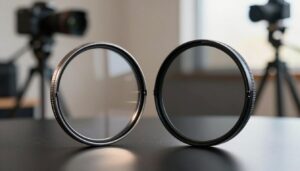
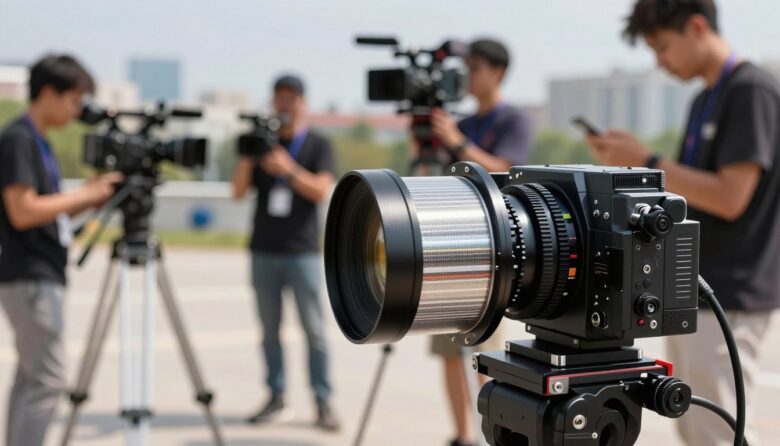
Magnetic ND filters are designed to reduce the time spent threading and unthreading filters during a shoot. A base or adapter ring remains attached to the lens, allowing compatible filters to be mounted, removed, or exchanged with a magnetic connection.
This can be especially useful when filming events, documentaries, outdoor interviews, travel sequences, or other situations where changing light does not wait for the camera operator. The advantage is primarily workflow speed—not an automatic improvement in image quality.
Magnetic ND filters make the most sense when rapid filter changes are a regular part of your work. They allow the threaded adapter to stay on the lens while the optical filter is exchanged more quickly.
They are less valuable when you use one density for an entire controlled shoot, rarely change filters, or already work with a matte box that provides fast filter-tray changes.
What Is a Magnetic ND Filter?
A magnetic ND filter combines neutral-density glass with a frame designed to connect to a matching magnetic base, adapter, or holder. The base normally attaches to the lens using its standard front filter thread.
Once the base is installed, compatible filters can be placed onto it without threading each filter directly into the lens. Some systems rely mostly on magnetic force, while others add a twist, notch, handle, screw, or locking mechanism for greater security.
Base or Adapter Ring
This is the threaded part that connects the magnetic system to the lens. It should match the lens’s front filter diameter or an approved step-up ring.
Fixed or Variable ND
The magnetic filter may provide one fixed density, such as 3 or 6 stops, or an adjustable variable-ND range.
Locking Mechanism
Selected systems require the filter to be rotated or secured after attachment. This adds protection against accidental movement or separation.
Front and Rear Caps
Matching caps protect the base ring and optical surfaces when the filter is mounted, removed, or stored between scenes.
Matching diameter does not guarantee compatibility. An 82 mm magnetic filter from one product family may not fit an 82 mm base from another because frame shape, magnetic placement, polarity, locking tabs, and mounting depth can differ.
Why Speed Matters During Filming
Video exposure often begins with creative choices that the operator does not want to change every time the scene becomes brighter or darker. Frame rate, shutter speed, aperture, and ISO may already be selected for motion, depth of field, image quality, or a recording profile.
An ND filter controls excess light while allowing those settings to remain closer to the intended values. When the location changes from shade to direct sun, a rapid filter swap can be more practical than repeatedly altering the complete camera setup.
| Filming situation | Exposure challenge | How a magnetic system may help |
|---|---|---|
| Outdoor interview | Clouds repeatedly change the brightness | Allows a lighter or stronger ND to be exchanged with less interruption |
| Event coverage | The camera moves between indoor and outdoor areas | The filter can be removed or replaced while the adapter remains on the lens |
| Documentary filming | Unrepeatable activity continues while lighting changes | Reduces time spent carefully threading a new filter |
| Travel video | The operator works with a small crew or alone | Simplifies changes when there is no assistant managing accessories |
| Golden-hour sequence | Light intensity falls quickly near sunset | Allows strong filtration to be removed as natural light decreases |
| Gimbal work | The camera must remain ready for moving shots | Reduces handling around the front thread, although balance must still be checked |
Speed does not remove the need for verification. After every filter change, confirm exposure, white balance, corner brightness, reflections, and the security of the connection before recording.
Magnetic Filters Versus Traditional Screw-In Filters
| Feature | Magnetic system | Traditional screw-in filter |
|---|---|---|
| Filter changes | Filter attaches to a prepared magnetic base | Each filter threads directly onto the lens or another filter |
| Setup time | Initial base installation is followed by faster compatible swaps | Every change requires alignment and several rotations |
| Cross-threading risk | Lower during normal swaps because the base remains attached | Possible whenever a filter is threaded hastily or at an angle |
| Security | Depends on magnetic force and any locking design | Secure when correctly threaded without overtightening |
| System compatibility | Usually limited to a matching product family | Standard thread sizes provide broader cross-brand compatibility |
| Cost to expand | May require proprietary filters, bases, caps, and adapters | Many standard filters work with any matching thread size |
| Stacking | Can be rapid when the system officially supports it | Possible by threading filters together |
| Lens hood use | May be restricted by the wider magnetic frame | Varies by filter thickness and hood design |
A screw-in filter is not obsolete. It remains a reliable and widely compatible option for photographers or filmmakers who rarely change density during a session. A magnetic system becomes more valuable when repeated swaps are part of the normal workflow.
Fixed Magnetic ND Versus Magnetic Variable ND
Fixed Magnetic ND
A fixed filter provides one stated reduction, such as 3, 6, or 10 stops. Changing exposure requires exchanging the complete filter.
- Useful for repeatable exposure settings
- No variable-ND cross pattern
- Available in strong densities
- Requires carrying several filters for several strengths
Magnetic Variable ND
A magnetic VND attaches quickly and then uses a rotating adjustment to change density within its stated working range.
- Fine exposure adjustment without exchanging filters
- Useful when light changes continuously
- May combine magnetic mounting with a separate lock
- Must be checked for polarization and color artifacts
A variable ND usually provides the greatest speed because the operator can adjust density without removing it. Fixed magnetic filters provide simpler and more repeatable optical behavior while still reducing the time required to exchange one strength for another.
Magnetic Mounting Does Not Determine Image Quality
The magnetic connection is a mechanical feature. It does not automatically improve sharpness, color accuracy, contrast, or flare resistance.
Optical performance still depends on:
- The quality and flatness of the filter glass
- The consistency of the ND coating
- Color behavior at different densities
- Anti-reflective coatings
- Filter thickness and frame design
- The number of filters being stacked
- The lens, focal length, lighting angle, and camera sensor
- Cleanliness of every optical surface
Evaluate the filter and the mounting system separately. A system can provide excellent handling but unsuitable color, or strong optical performance with a connection that does not fit your filming style.
Can a Magnetic Filter Fall Off?
A correctly matched filter should remain attached during ordinary use, but connection strength and security vary between systems. Some products add a rotational lock, screw, notch, or mechanical retention feature rather than relying only on magnetic force.
Test the connection carefully before using it during:
- Running or handheld documentary work
- Vehicle-mounted filming
- Fast gimbal movements
- Strong wind
- Crowded events where the filter may be bumped
- Filming above water, balconies, or hard surfaces
Do not perform a violent shake test with expensive glass attached. Hold the camera above a padded surface, follow the locking instructions, and apply only gentle movement while checking that the filter is fully seated.
How Stacking Changes the Workflow
Some magnetic systems support stacking an ND filter with a polarizer, diffusion filter, graduated filter, or another approved element. This can make creative changes faster, but every added layer should be treated as another optical and mechanical variable.
ND and Diffusion
The ND controls exposure while the diffusion filter changes highlight bloom, contrast, and fine-detail rendering.
ND and Polarizer
The ND controls brightness while the polarizer changes reflections and selected areas of the scene.
Additional Reflections
More air-to-glass surfaces can increase the chance of flare, ghosting, or reduced contrast in strong backlight.
Frame Thickness
A deeper stack may become visible in the corners of a wide-angle image or interfere with the original lens hood.
Use only combinations officially supported by the system. Check whether the filters must be attached in a specific order and whether the locking mechanism secures the complete stack.
Wide-Angle Lenses and Vignetting
Magnetic systems can be designed with slim frames, but wide-angle compatibility should never be assumed. Lens design, sensor size, focal length, base-ring thickness, filter diameter, and the number of stacked elements all affect corner coverage.
Using One System Across Several Lenses
A magnetic system can be shared by choosing one large filter diameter and installing compatible base rings or step-up adapters on smaller lenses.
For example, a filmmaker with 67 mm, 77 mm, and 82 mm lenses may build the filter kit around 82 mm. The smaller lenses then use approved adapters that accept the same magnetic filters.
| Lens thread | Shared filter size | Possible connection | What to verify |
|---|---|---|---|
| 82 mm | 82 mm magnetic system | Direct 82 mm base | Frame thickness and wide-angle compatibility |
| 77 mm | 82 mm magnetic system | Compatible 77–82 mm adapter or step-up arrangement | Whether the adapter replaces or requires a separate base ring |
| 67 mm | 82 mm magnetic system | Compatible 67–82 mm adapter or step-up arrangement | Lens hood, cap, balance, and filter clearance |
Check the manufacturer’s adapter instructions. In some systems, the step-up ring also acts as the magnetic base. In others, a traditional step-up ring must be combined with a separate base plate.
When Magnetic ND Filters Help Most
Run-and-Gun Video
Rapid filter removal or replacement helps when moving between shade, direct sun, interiors, and reflective locations.
Events and Documentaries
The operator can spend less time aligning threads while important activity continues in front of the camera.
Solo Filmmaking
Quick-access filters can simplify equipment management when one person is handling camera, sound, exposure, and composition.
Commercial and Music Video
Compatible ND and diffusion elements can be exchanged between looks without rebuilding the complete front-lens setup.
Travel Production
One shared magnetic diameter may reduce the number of duplicate filters carried for lenses with smaller thread sizes.
Outdoor Interviews
Different fixed strengths or VND ranges can be exchanged when cloud cover changes beyond the useful range of the attached filter.
When a Magnetic System May Not Be Necessary
- You normally install one filter and leave it attached for the complete session.
- You work in a controlled studio where exposure rarely changes.
- Your existing matte box already provides efficient filter-tray changes.
- You prioritize broad cross-brand compatibility over a proprietary ecosystem.
- Your specialty lens requires a dedicated rear filter, drop-in system, or custom holder.
- You need to use the original lens hood at all times.
- Your work places the camera in situations where a mechanically locked cinema filter tray is more appropriate.
The fastest system is not always the most suitable system. Choose the mounting method that fits the risks, pace, and equipment requirements of the production.
What to Check Before Buying
A Reliable Fast-Paced Filming Workflow
- Install the base ring before the shoot. Attach it squarely, keep the threads clean, and tighten only until secure.
- Organize filters by density. Use labeled case positions so the correct filter can be identified without touching several optical surfaces.
- Select frame rate and shutter speed. Decide how motion should look before using ND to control brightness.
- Set aperture and ISO. Choose depth of field and the camera’s appropriate sensitivity before selecting filter strength.
- Attach the required ND. Align the filter correctly and complete any twist, screw, or locking action required by the system.
- Check the connection. Confirm that the filter is completely seated and does not rock or rotate unexpectedly.
- Verify exposure and color. Use zebras, waveform, histogram, or another available exposure tool. Lock white balance when consistency matters.
- Inspect the complete frame. Look for dark corners, uneven density, cross-polarization, reflections, and flare.
- Record a short test clip. Review motion, highlights, skin tones, fine detail, and filter security before the main take.
- Return filters directly to the case. Do not place exposed filter glass in a pocket, on the ground, or loosely inside the camera bag.
Testing a New Magnetic Filter System
Test the system in a controlled environment before depending on it during an important production.
| Test | How to perform it | What to look for |
|---|---|---|
| Attachment test | Mount and remove each filter several times above a padded surface | Misalignment, rocking, weak seating, or confusing locking steps |
| Wide-angle test | Use the widest focal length and every intended filter stack | Hard dark corners, frame intrusion, or uneven density |
| Color test | Record a gray card or color chart with locked white balance | Warm, cool, green, or magenta shifts between filters |
| Backlight test | Place a strong light near or inside the edge of the frame | Flare, ghosting, haze, and reduced contrast |
| Detail test | Record text, fabric, foliage, or distant architecture | Loss of fine detail or uneven sharpness |
| Movement test | Perform gentle handheld and gimbal movements | Unexpected filter movement or balance changes |
| Swap test | Simulate moving from shade to direct daylight | Whether the filter organization is genuinely faster and less distracting |
Save the test files. A labeled comparison gives you a reference for choosing density, correcting color, and deciding which filter combinations are dependable.
Common Mistakes to Avoid
Cleaning and Storage
Frequently Asked Questions
Are magnetic ND filters faster than screw-in filters?
They are designed to shorten normal filter changes because the threaded base remains on the lens. Actual speed depends on the system’s alignment, locking process, filter organization, and operator practice.
Do magnetic filters improve image quality?
Not automatically. Magnetic mounting changes how the filter attaches. Optical quality still depends on the glass, coatings, density consistency, reflections, cleanliness, and manufacturing quality.
Can a magnetic ND filter fall from the lens?
A compatible and correctly secured system should remain attached during intended use, but security varies by design. Complete every required locking step and test the setup before dynamic filming.
Can magnetic filters from different brands be combined?
Do not assume they can. Identical stated diameter does not guarantee matching magnets, frame depth, polarity, alignment features, or locking mechanisms.
Can magnetic ND filters be stacked?
Some systems support stacking, but the approved number and order vary. Additional glass can increase flare, reflections, color changes, and vignetting, so every combination should be tested.
Can I use a magnetic filter with a step-up ring?
Often yes, but the required arrangement depends on the product. Some manufacturers offer a step-up adapter that also functions as the magnetic base, while others require a separate base ring.
Are magnetic filters suitable for gimbal filming?
They can be, especially when quick changes are useful. Adding or removing front weight may affect balance, so confirm motor performance and rebalance when required.
Can I keep the base ring permanently attached?
Many systems are designed attached?
Many systems are designed for the base to remain on the lens during normal use. Protect it with the correct cap and inspect the thread and magnetic surface regularly.
Will a magnetic system work with the original lens hood?
Compatibility varies. Wider filter frames and adapters may prevent the original hood from attaching or may cause vignetting. Follow the system manufacturer’s guidance.
Should I choose fixed magnetic ND or magnetic VND?
Choose fixed filters for predictable densities and repeatable exposure. Choose a magnetic VND when continuous adjustment and changing light are more important. A hybrid kit can contain both.
What is the best first magnetic ND range for video?
A moderate range around 2–5 stops covers many everyday outdoor situations. Strong sunlight, high base ISO, or wide apertures may require a separate stronger range such as 6–9 stops.
Are magnetic filters worth the extra cost?
They provide the greatest value when frequent filter changes interrupt your work. A filmmaker who rarely changes density may receive little benefit compared with a good screw-in filter.
Final Recommendation
Magnetic ND filters are a workflow tool, not a shortcut around careful exposure or optical testing.
They are most useful for filmmakers who regularly move between different light levels and need to exchange filters without repeatedly threading glass onto the lens. A good system should provide a secure connection, clear compatibility, useful ND strengths, protective storage, and acceptable optical performance on your widest lens.
Before relying on a magnetic system for an important shoot, practice the attachment process, test every intended stack, inspect color and vignetting, and confirm that the filter remains secure during the actual camera movements required by the production.

The OptiFilter Labs Editorial Team creates practical, carefully researched content about ND filters, camera accessories, exposure control, photography techniques, and video production. Our goal is to help photographers and filmmakers understand their equipment, solve common problems, and make more informed purchasing decisions.