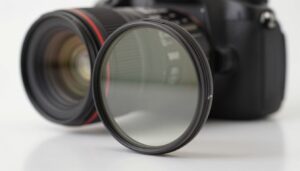
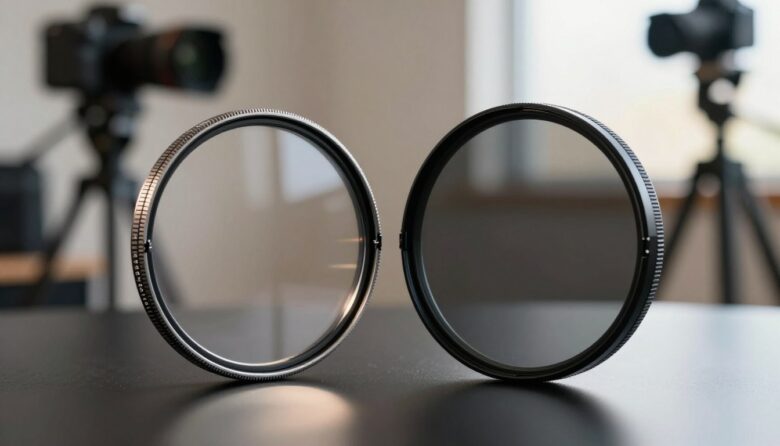
Variable and fixed ND filters solve the same basic problem: they reduce the amount of light reaching the camera so you can keep the shutter speed, aperture, and ISO settings needed for a particular creative result.
The difference is in how that light reduction is controlled. A fixed ND provides one specific density, while a variable ND lets you adjust the strength by rotating its front ring. Neither design is automatically better. The right choice depends on how quickly the light changes, how much consistency you need, and whether you are shooting still photographs, video, or both.
Choose a variable ND when you need fast exposure changes for video, travel, events, interviews, or changing daylight.
Choose fixed ND filters when you want repeatable densities for long exposures, controlled productions, landscapes, or situations where you can take time to change filters.
Best for Speed and Flexibility
- Adjustable light reduction in one filter
- Fast response to changing daylight
- Convenient for video and run-and-gun work
- Fewer separate filters to carry
- Requires careful checking for polarization artifacts
Best for Repeatability and Simplicity
- One predictable density per filter
- No variable-ND cross pattern
- Useful for calculated long exposures
- Available in light to extremely strong densities
- Requires filter changes when conditions shift
What an ND Filter Actually Does
A neutral density filter reduces incoming light without requiring the camera operator to close the aperture, increase shutter speed, or lower ISO beyond the desired setting.
This is useful when you want to:
- Use a wide aperture for shallow depth of field in bright light
- Maintain a video shutter speed that produces natural motion blur
- Create longer photographic exposures without overexposing the image
- Keep exposure settings consistent across several cameras or shots
- Control brightness when the camera has a limited minimum ISO
ND strength is normally expressed in stops. Each additional stop halves the light that reaches the sensor.
| Reduction | Light transmitted | Common label | Typical application |
|---|---|---|---|
| 1 stop | 1/2 | ND2 or ND 0.3 | Small exposure adjustment |
| 2 stops | 1/4 | ND4 or ND 0.6 | Cloudy daylight or wide-aperture portraits |
| 3 stops | 1/8 | ND8 or ND 0.9 | Moderate daylight and video exposure control |
| 6 stops | 1/64 | ND64 or ND 1.8 | Longer exposures and strong daylight |
| 10 stops | 1/1024 | ND1000 or ND 3.0 | Long-exposure landscapes in daylight |
Label warning: Manufacturers may describe the same density using a stop value, an ND factor, or optical density. Always confirm the actual stop reduction instead of relying only on the number printed after “ND.”
How Variable ND Filters Work
A variable ND filter normally uses two polarizing elements. Rotating one element changes how much light passes through the combined filter, allowing the density to be adjusted without removing it from the lens.
Common working ranges include approximately 1–5, 2–5, or 6–9 stops. A limited range can be easier to control than a single filter that attempts to cover everything from light reduction to extremely strong density.
Fast Exposure Changes
Turning the ring is quicker than unscrewing one fixed filter and attaching another, which is valuable when clouds, subjects, or camera positions change rapidly.
Smaller Working Kit
One adjustable filter can replace several light or medium fixed densities, reducing the number of separate filters carried in a bag.
Useful for Video
A variable ND makes it easier to preserve a selected shutter speed and aperture while outdoor light changes during filming.
Fine Adjustment
Density can be changed gradually rather than only in full-stop jumps, although printed markings may not always function as laboratory-precise exposure measurements.
Variable ND Limitations
The polarizing design that creates convenient adjustment can also introduce effects that do not occur in the same way with a standard fixed ND.
- Cross-polarization: An X-shaped dark pattern may appear when some VND filters are rotated near or beyond their usable maximum.
- Uneven skies: Wide-angle scenes can show inconsistent sky brightness because polarization varies across the field of view.
- Changed reflections: Water, glass, leaves, paint, and metal may look different as the filter is rotated.
- Color shift: Some products become warmer, cooler, greener, or more magenta at different densities.
- Thicker frame: The two-layer construction and rotating ring can increase the chance of vignetting on wide lenses.
A variable ND should not be rotated by watching brightness alone. Check the entire frame for an X pattern, uneven skies, changing reflections, color shifts, and dark corners before recording an important clip.
How Fixed ND Filters Work
A fixed ND filter provides one stated amount of light reduction. A 3-stop filter always aims to reduce light by three stops, while a 6-stop or 10-stop filter provides a stronger, predetermined reduction.
To change density, the photographer must replace the filter, use a different slot in a holder system, or combine compatible filters. This takes more time, but it makes exposure changes easier to calculate and repeat.
Predictable Density
A fixed stop value is useful when calculating shutter speed for long-exposure photography or repeating a controlled camera setup.
No VND Cross Pattern
Because a normal fixed ND does not rely on rotating polarizers, it does not create the X-shaped artifact associated with variable ND over-rotation.
Very Strong Options
Fixed filters are readily available in strong densities such as 6, 10, 15, or more stops for specialized long-exposure work.
Holder-System Compatibility
Square and rectangular filters can be combined with graduated ND filters in holder systems designed for landscape photography.
Fixed ND Limitations
- Changing density requires stopping to replace or rearrange filters.
- A complete set can occupy more space and cost more than one adjustable filter.
- Screw-in filters may become stuck when tightened too firmly.
- Stacking multiple filters can increase flare, reflections, color changes, and vignetting.
- A fixed ND can still affect color or sharpness if its optical quality is poor.
Fixed does not automatically mean perfectly neutral. Coating quality, glass quality, density, infrared behavior, reflections, and manufacturing consistency can affect any ND filter.
Variable Versus Fixed ND: Direct Comparison
| Feature | Variable ND | Fixed ND |
|---|---|---|
| Density control | Adjusted by rotating the filter | One density per filter |
| Speed in changing light | Excellent | Slower because filters must be changed |
| Exposure repeatability | Depends on markings and filter design | Usually straightforward |
| Cross-polarization risk | Possible, especially near strong settings | Not associated with standard fixed ND construction |
| Effect on reflections | Can change as the ring rotates | Normally does not behave like a rotating polarizer |
| Strong long exposures | Possible with selected models, but not always ideal | Well suited to calculated 6–15+ stop exposures |
| Portability | One filter may cover several densities | Several strengths may be needed |
| Wide-angle use | Requires testing for uneven polarization and thick-frame vignetting | Requires testing for frame or holder vignetting |
| Video workflow | Usually more convenient | Useful in controlled lighting or matte-box systems |
| Landscape workflow | Useful when light changes quickly | Useful for planned and calculated long exposures |
Which Filter Fits Your Workflow?
Outdoor Filmmaking
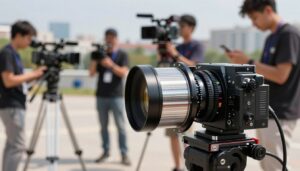
A variable ND is often the more practical choice because it lets you preserve shutter speed and aperture while light changes. A 2–5 stop range covers many situations, while stronger daylight may require a 6–9 stop model.
Long-Exposure Landscapes
Fixed 6-stop and 10-stop filters provide predictable reductions that make shutter-speed calculations easier. A holder system can also accommodate graduated filters when the sky is brighter than the foreground.
Events and Documentary Work
A variable ND reduces interruption when moving between shade, open sun, and indoor locations. Check reflections and skin tones whenever the filter position changes.
Studio and Commercial Shoots
Fixed filters are useful when lighting and camera positions remain stable. Variable filters are still convenient when small exposure adjustments must be made without changing depth of field.
Travel Photography
A good variable ND can reduce the number of filters carried. A fixed 6-stop filter may be preferable when long-exposure landscapes are the main goal.
Wide Apertures in Bright Sun
Both types work. A variable ND is faster when the subject moves between different light levels, while a fixed 2-stop or 3-stop filter provides a simple solution in steady light.
A Simple Decision Process
- Identify your main subject. Video, portraits, landscapes, travel, events, and long exposures place different demands on a filter.
- Decide how quickly the light changes. Rapid changes favor a variable filter. Stable conditions make fixed filters easier to manage.
- Estimate the strength you need. Light and medium densities are common for video and portraits. Strong fixed densities are more practical for extended daylight exposures.
- Check your widest lens. Wide focal lengths reveal VND polarization problems, thick-frame vignetting, and undersized holder systems more easily.
- Consider repeatability. Fixed densities are easier to document precisely. A marked VND can still be repeatable, but verify how accurate its markings are.
- Choose the largest practical filter size. A large filter with step-up rings can work across several smaller lenses and reduce unnecessary duplication.
- Test before important work. Record or photograph a plain wall, clear sky, reflective surface, skin tones, and fine detail at every density you expect to use.
How to Test a Variable ND Filter
A useful test should examine more than overall brightness.
How to Build a Practical ND Filter Kit
Simple Video Kit
- One 2–5 stop variable ND
- One 6–9 stop variable ND for strong sunlight
- Step-up rings for smaller lenses
- Protective case and optical cleaning cloth
Simple Photography Kit
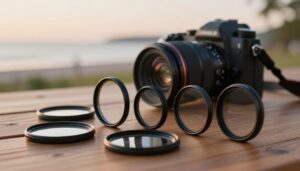
- One 3-stop fixed ND for moderate light control
- One 6-stop fixed ND for medium long exposures
- One 10-stop fixed ND for extended daylight exposures
- Filter holder or step-up rings appropriate for the lens kit
Hybrid Photo and Video Kit
- One 2–5 stop variable ND for video and portraits
- One fixed 6-stop or 10-stop ND for long exposures
- One large standard filter diameter shared through step-up rings
- A reliable case that keeps each optical surface separated
A hybrid kit is often more useful than choosing one design exclusively. A variable ND handles quick exposure changes, while one strong fixed ND covers long-exposure situations that fall outside the most practical VND range.
Common Buying Mistakes
- Buying an extremely broad VND without testing it: Very wide ranges may be difficult to use evenly at their strongest positions.
- Assuming every expensive filter is perfectly neutral: Price alone does not guarantee accurate color or edge-to-edge consistency.
- Ignoring filter thickness: A thick frame can create dark corners on wide-angle lenses.
- Purchasing a filter for every lens: One larger filter with step-up rings may be more economical.
- Stacking several filters unnecessarily: Extra glass increases the chance of reflections, flare, color shifts, and vignetting.
- Using maximum density without checking the frame: The image can look correctly exposed in the center while remaining uneven near the edges.
- Forgetting the camera’s base ISO: Some recording profiles require stronger ND because they operate at a higher minimum or base ISO.
Frequently Asked Questions
Is a fixed ND always sharper than a variable ND?
No. A high-quality variable ND can preserve excellent detail, while a poor fixed filter can reduce contrast or sharpness. Fixed filters have a simpler design, but actual results depend on the glass, coatings, density, lens, and lighting.
Are variable ND filters suitable for photography?
Yes. They are useful for portraits, travel, events, waterfalls, and other situations where light changes quickly. Strong calculated long exposures are often easier with fixed filters.
Why does a variable ND create an X pattern?
The pattern results from cross-polarization between the filter’s rotating layers, usually near an extreme setting. Reduce the density or use a filter with hard stops and a narrower working range.
Can a variable ND replace every fixed filter?
Not always. A variable ND can replace several light or medium densities, but fixed filters remain useful for strong long exposures, controlled repeatability, and situations where polarization effects are undesirable.
Can fixed ND filters be stacked?
They can, provided the filters and holder support it. However, stacking can increase reflections, color shifts, flare, and vignetting. A single filter with the required density is generally cleaner.
What VND range is best for a first purchase?
A range around 2–5 stops is a practical starting point for many video creators and portrait photographers. Strong midday light, high base ISO, or very wide apertures may require a separate 6–9 stop option.
Which type is better for wide-angle lenses?
Either can work, but both require testing. Variable filters may show uneven polarization, while thick fixed-filter frames and holders may create mechanical vignetting. Use a slim, correctly sized system.
Does an ND filter change depth of field?
Not directly. It reduces light so you can select a wider aperture in bright conditions. The wider aperture is what creates a shallower depth of field.
Should beginners buy both types?
Beginners do not need a large collection immediately. Start with the type that matches your main workflow. A video creator may begin with a variable ND, while a long-exposure photographer may begin with a fixed 6-stop or 10-stop filter.
Final Recommendation
A variable ND is the most practical starting point for filmmakers, event shooters, travelers, and photographers who regularly work in changing light.
Fixed ND filters are better suited to calculated long exposures, repeatable setups, and workflows where filter changes can be made without pressure.
Many hybrid creators benefit from owning both: a moderate variable ND for quick adjustments and one strong fixed ND for long-exposure photography. Before relying on either design, test color, sharpness, reflections, corner brightness, and exposure consistency on your own camera and widest lens.

The OptiFilter Labs Editorial Team creates practical, carefully researched content about ND filters, camera accessories, exposure control, photography techniques, and video production. Our goal is to help photographers and filmmakers understand their equipment, solve common problems, and make more informed purchasing decisions.